


A Decade of Data Decoded — Know Exactly Where UPSC Is Heading and Prepare Smarter
Why Should You Study Trends Before Studying Topics?
Most UPSC aspirants start by picking up books and notes — but the smartest ones start by understanding where UPSC is asking questions from. The UPSC Preliminary Examination (GS Paper 1) has 100 questions, and over the last 11 years, a clear pattern has emerged in how many questions come from each subject.
At Fortune IAS Academy, we have closely tracked this data year after year. This blog breaks down the UPSC Prelims Trend Analysis from 2015 to 2025, subject by subject, so you can allocate your preparation time wisely — and not waste months on areas that are becoming less important.
Important Note: GS Paper 1 (100 questions x 2 marks = 200 marks) is the merit-determining paper in Prelims. Only those who clear the Prelims cutoff proceed to Mains. Every question matters — and knowing which subjects to prioritise can make or break your score.
The Complete Data: Subject-wise Questions (2015–2025)
The table below shows the number of questions asked from each subject across 11 years of UPSC Prelims.
| Year | Current Affairs | History | Geography | Polity | Economy | Sci & Tech | Environment |
|---|---|---|---|---|---|---|---|
| 2015 | 29 | 14 | 14 | 13 | 13 | 7 | 10 |
| 2016 | 27 | 15 | 7 | 7 | 18 | 8 | 18 |
| 2017 | 34 | 14 | 7 | 22 | 8 | 4 | 11 |
| 2018 | 28 | 15 | 8 | 13 | 16 | 7 | 13 |
| 2019 | 22 | 17 | 14 | 15 | 14 | 7 | 11 |
| 2020 | 18 | 20 | 10 | 17 | 15 | 10 | 10 |
| 2021 | 17 | 15 | 10 | 11 | 16 | 14 | 17 |
| 2022 | 10 | 11 | 9 | 21 | 16 | 15 | 18 |
| 2023 | 15 | 14 | 16 | 15 | 14 | 12 | 14 |
| 2024 | 13 | 12 | 18 | 15 | 14 | 13 | 15 |
| 2025 | 13 | 12 | 14 | 15 | 21 | 15 | 10 |
Subject-wise Deep Dive: What the Trends Tell You
Let us go subject by subject and understand what the numbers reveal — and, more importantly, what it means for your preparation.
Current Affairs — Sharp Decline
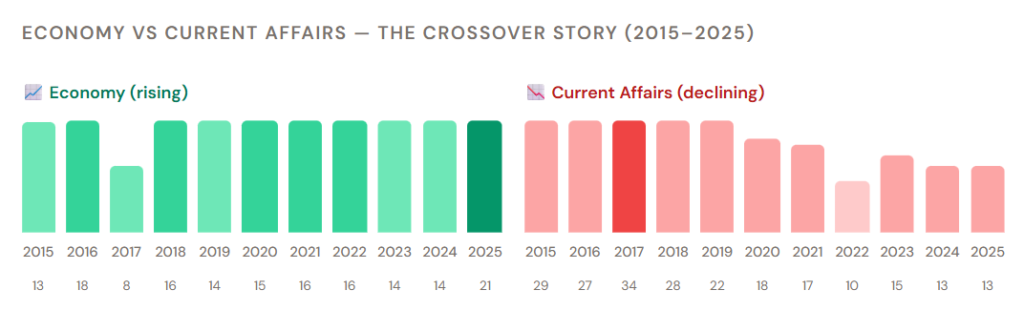
This was the dominant subject in 2015-2018, peaking at 34 questions in 2017. But the fall has been dramatic — hitting a low of just 10 questions in 2022 and now stabilising around 13 (2024 and 2025). UPSC has clearly moved away from plain current affairs recall. The era of the newspaper-only aspirant is well and truly over.
History — Stable and Consistent
History has remained one of the most consistent subjects — always between 11 and 20 questions. It peaked at 20 questions in 2020 and currently sits at 12. Ancient, Medieval, and Modern History (especially the Freedom Struggle) are all tested regularly. Consistent preparation here is well rewarded.
Geography — Quietly Rising
Geography dipped to a low of just 7 questions in 2016-2017, but has since made a strong comeback — touching 18 questions in 2024. Both Physical Geography and India-specific topics are being tested more. A subject that aspirants underestimate at their peril.
Polity — Highly Volatile
Polity is the most unpredictable subject in the Prelims — ranging from a low of 7 questions in 2016 to a high of 22 questions in 2017. In recent years (2022, 2024, 2025), it has settled around 15-21. You cannot afford to skip Polity — it can swing your score massively in either direction.
Economy — The Big Winner in 2025
Economy recorded its highest-ever count of 21 questions in 2025 — surpassing even its previous peak of 18 in 2016. The trend shows consistent importance from 2020 onwards. Budget, RBI policies, schemes, and macroeconomics are all fair game. Economy must now be treated as a top-priority subject.
Science & Technology — The Biggest Growth Story
This is the biggest success story of the decade. Science & Technology went from a meagre 4 questions in 2017 to 15 questions in 2025. Emerging technologies — space, biotech, AI, defence — are regularly tested. Ignoring this subject is no longer a viable strategy.
Environment — Consistently Important
Environment has consistently stayed between 10-18 questions over 11 years — peaking at 18 in both 2016 and 2022. It dipped to 10 in 2025. Topics like biodiversity, climate change, pollution, and national parks are regularly featured. It remains a high-return subject with predictable coverage.
5 Big Insights Every Aspirant Must Know
Insight 1: Current Affairs Alone Will Not Save You
In 2015, a well-read newspaper aspirant could answer around 29 questions. In 2025, that number is just 13. UPSC wants conceptual understanding, not just awareness of events. Reading the newspaper without connecting it to the UPSC syllabus is not enough.
Insight 2: Economy is the New King
With 21 questions in 2025 — the highest count of any subject that year — Economy has emerged as the top priority. If you have been treating Economy as secondary, it is time to reverse that decision immediately.
Insight 3: No Subject Can Be Left Out
Every single subject — even Science & Technology, which was just 4 questions in 2017 — has climbed to 15 questions by 2025. UPSC’s increasingly broad-based approach means gaps in any area can be very costly.
Insight 4: Geography and Science & Technology are Underrated
Geography went from 7 to 18 questions; Science & Technology from 4 to 15. Both are areas where systematic preparation can yield excellent returns with relatively focused effort. Most aspirants underinvest here.
Insight 5: Polity Can Decide Your Fate
Polity has oscillated between 7 and 22 questions over 11 years. In years with 20+ Polity questions, unprepared aspirants lose enormous ground. Treating Polity as a certainty — and preparing it thoroughly — is the safest strategy.
How to Use This Trend Data for Your Preparation
Data is only useful when it translates into action. Here is how to apply these trends to your daily study plan:
- Prioritise Economy now. With 21 questions in 2025, Economy deserves at least 15-20% of your Prelims study time. Study NCERT Economics (Class 9-12), the Economic Survey summary, and Budget highlights.
- Do not abandon Current Affairs — connect it to concepts. Though questions have dropped, current affairs still form the context for many questions across all subjects. Read the newspaper but focus on understanding the ‘why’ behind the news.
- Revise History systematically, not desperately. With a stable 12-15 question range, History is predictable. A thorough reading of Spectrum’s Modern History and NCERT Ancient & Medieval is sufficient.
- Take Geography seriously this cycle. After hitting 18 questions in 2024, Geography is clearly being weighted more. Maps, physical geography, and India-specific geography all need attention.
- Build a Science & Technology reading habit. With 15 questions in 2025, it is no longer a subject you can defer. Follow science-focused current affairs — space missions, biotech, defence — as a daily habit.
- Do not neglect Environment. Despite dipping to 10 in 2025, it has historically gone up to 18. Shankar IAS Environment and PIB summaries are your best resources here.
- Keep Polity sharp always. Given its volatile nature, Polity can be both a lifesaver and a weakness. M. Laxmikanth remains the gold standard. Read it at least twice before Prelims.
Conclusion: Preparation is a Strategy Game
The UPSC Prelims is not just a test of hard work — it is a test of smart strategy. The trend data from 2015 to 2025 is your single most powerful planning tool. It tells you where UPSC is spending its questions, how subjects are rising and falling, and what you can no longer afford to skip.
The era of Current Affairs-heavy preparation is over. The new UPSC Prelims rewards aspirants who have built conceptual depth across all seven subject areas — especially Economy, Science & Technology, and Geography, which have all seen significant growth over the past decade.
At Fortune IAS Academy, our entire teaching approach is built around this data-driven insight. Our faculty, test series, and study materials are all calibrated to the evolving UPSC pattern — so that when you walk into the exam hall, you are never surprised.
5 Big Insights Every Aspirant Must Know
In 2015, a well-read newspaper aspirant could answer ~29 questions. In 2025, that number is just 13. UPSC wants conceptual understanding, not just awareness of events.
With 21 questions in 2025 — the highest count of any subject that year — Economy has emerged as the top priority. If you have been treating Economy as secondary, it's time to reverse that immediately.
Every single subject — even Sci & Tech which was just 4 questions in 2017 — has climbed to 15 questions by 2025. UPSC's increasingly broad-based approach means gaps in any area can be costly.
Geography went from 7 to 18 questions; Science & Tech from 4 to 15. Both are areas where systematic preparation can yield excellent returns with relatively focused effort.
Polity has oscillated between 7 and 22 questions over 11 years. In years with 20+ Polity questions, unprepared aspirants lose enormous ground. Treating Polity as a certainty is the safest strategy.