

[elementor-template id="18608"]

Are you a beginner aspiring to become an IAS, IPS, or IFS officer? One of the first and most crucial steps in your UPSC journey is understanding the eligibility criteria, especially the age limit. At Fortune IAS Academy, we believe clarity from the start prevents disappointment later. This comprehensive guide covers everything General category candidates need to know about UPSC age limits, attempts, and relaxation rules.


Why the Age Limit Matters


The UPSC sets specific age criteria to ensure a standardised and fair selection process for India’s prestigious civil services, including the IAS, IPS, and IFS. Misunderstanding these rules can mean missing your chance, so let’s clarify them.


UPSC Age Limit for General Category: The Core Rules


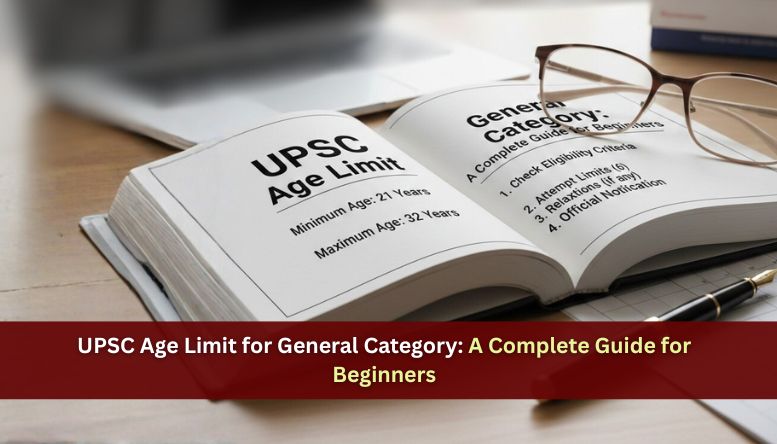
For beginners, here are the fundamental age criteria you must know:

Criteria

Rule for General Category

Minimum Age

21 years as of August 1st of the exam year.

Maximum Age

32 years as of August 1st of the exam year.

Number of Attempts

6 attempts (until the age limit is reached).

For the UPSC CSE 2026 cycle, you must be at least 21 years old and not older than 32 years as of 1st August 2026 to be eligible under the General category.


Understanding the “Number of Attempts” Rule

The “6 attempts” rule is often a source of confusion. Remember:

*   An attempt is counted only when you appear for the Preliminary Examination. Merely filling out the application form does not count.

*   The attempt limit is linked to the age limit. A General Category candidate can appear a maximum of 6 times, but only until they turn 32.


Age Relaxation & Additional Attempts for Other Categories


While this guide focuses on the General category, it’s helpful to know the relaxations provided to others. This table gives you a complete picture:

Category

Upper Age Relaxation

Maximum Age Limit

Number of Attempts

General / EWS

No Relaxation

32 years

6

OBC (Non-Creamy Layer)

3 years

35 years

9

SC / ST

5 years

37 years

Unlimited (until age limit)

PwBD (General)

10 years

42 years

9

PwBD (OBC)

13 years

45 years

9

PwBD (SC/ST)

15 years

47 years

Unlimited (until age limit)

Defence Services Personnel

Up to 3 years

35 years for Gen

Varies by category

Ex-Servicemen

Service period + 3 years

32 + Service Period

Varies by category


Note for Beginners: If you belong to a reserved category, ensure you have a valid central government certificate to claim relaxation.


Crucial Exceptions & Special Cases


Some circumstances grant extra attempts or age relaxation. Key ones include:


  1. Persons with Benchmark Disability (PwBD): Eligible for significant age relaxation and extra attempts as shown in the table.
  2. Ex-Servicemen & Commissioned Officers: Specific relaxation based on years of service.
  3. Domicile of Jammu & Kashmir: Candidates from J&K (1980-1989) may be eligible for additional relaxation.


Professional Tip: Always refer to the official UPSC notification for the year you are applying. It is the final authority on all eligibility norms.


Common Mistakes & FAQs for Beginners


Q1: My birthday is in September. I will be 21 in September, but the exam is in August. Am I eligible?


> No. You must be 21 years old on or before 1st August of the exam year. You would have to wait for the next cycle.


Q2: I am 32 years and 5 months old on 1st August. Am I eligible?


> Yes. The rule specifies “not more than 32 years,” meaning you are eligible as long as you have not turned 33 by 1st August.


Q3: Do my attempts get reset if I change my category (e.g., from General to OBC)?


> No. Your attempts are calculated per category. Previous attempts as a General candidate remain counted. However, you gain the higher age limit and attempt count of the OBC category from that point forward.


Q4: Where can I find the official notification?


> Visit the UPSC’s official website: https://www.upsc.gov.in

The notification is usually released in February each year.


Your Next Steps at Fortune IAS Academy


Understanding the age limit is just the first step in your UPSC journey. At Fortune IAS Academy, we guide you through the entire process:


  1. Eligibility Audit: We help you calculate your exact age and attempts to plan your strategy.
  2. Personalised Timeline: Based on your window, we help you to create an optimised study plan.
  3. Comprehensive Mentorship: From syllabus coverage to answer writing, we prepare you to crack the exam within your attempt limit.


Begin your journey with clarity and confidence. Book a counselling session with our experts at Fortune IAS Academy today to chart a winning strategy tailored to your eligibility.


📞+919495015888


Final Takeaway


For a General Category UPSC aspirant, the window is 21 to 32 years with 6 attempts. Use this window wisely. Start early, prepare strategically, and remember that understanding the rules is the foundation of a successful attempt.


Our Courses: Designed for Every Aspirant


Course

Designed For

Status

Online Working Professional Batch

Working professionals, students pursuing higher studies, or homemakers balancing other commitments.

✅Admissions Open

PCM (Prelims Cum Mains) Full-Time Batch

Full-time aspirants seeking integrated and intensive preparation for both Prelims and Mains.

✅Admissions Open

Fortune IAS Junior

School students aiming to build a strong early foundation for future UPSC preparation.

✅Admissions Open


[elementor-template id="18801"]


In a landmark event celebrating 100 years of the Union Public Service Commission (UPSC), Chairman Dr. Ajay Kumar did something unprecedented: he stepped into the spotlight for a live, candid town hall with civil services aspirants. This first-of-its-kind interaction broke down the ivory tower, addressing the very pulse of the exam community—reforms, fairness, coaching, and the secrets to success.

For anyone on the UPSC journey, here are the pivotal takeaways from this historic conversation.


A Centenary of Trust: Reaffirming UPSC’s Core Mission


Dr. Ajay Kumar began by framing the UPSC’s role not just as an examining body, but as the nation’s architect for its future leadership. As it enters its 100th year, the commission’s commitment to neutrality, meritocracy, and integrity remains stronger than ever. He emphatically stated that the UPSC is immune to external pressures and maintains a zero-tolerance policy towards any form of cheating, with strict penalties including multi-year debarment and criminal action.


Demystifying the Process: The Chairman’s Direct Answers


 1. The Rationale Behind Key Policies


   August 1st Cut-off Date: This isn’t an arbitrary date. It’s a deliberate policy that allows graduates completing their degrees in May-June to attempt the exam sooner, saving them a precious year. 

   CSAT is a Gatekeeper, Not a Kingmaker: Addressing the perennial “urban/engineering bias” charge, Dr. Ajay Kumar clarified that the CSAT, requiring just 33% to qualify, is a balanced paper. Its scores don’t count towards the final rank, and its design (split between language, math, and logic) ensures a level playing field for all backgrounds.


 2. Transparency & The Answer Key Debate


Why the delay in releasing prelims answer keys? The Chairman explained it’s a meticulous process involving subject experts and a review of candidate challenges to ensure absolute accuracy before release. He also revealed that the demand for immediate key release is currently sub judice before the Supreme Court.


 3. The “Why” of Optional Subjects


Defending their significant weightage (about 2/7th of the Mains score), he stated that optional subjects are crucial for assessing a candidate’s ability to achieve mastery and depth in a field—a key indicator of their capacity to grasp complex subjects as future civil servants.


 4. No Change in Age Limit or Attempt Rules


Addressing frequent rumors about potential changes, Dr. Ajay Kumar gave a clear and direct statement: “There is no proposal to change the age limit or number of attempts.” He emphasized that the current rules—32 years for the General category (6 attempts), 35 for OBC (9 attempts), and 37 for SC/ST (unlimited attempts)—are well-balanced and time-tested, having evolved to a stable state over the years.


Busting Aspirant Myths: Data Over Anecdotes


   Myth: Engineers have an unfair advantage.

       Reality: The data shows many successful engineers qualify with humanities optional subjects. Evaluation is anonymous, and the CSAT is only a qualifying hurdle. There is no inherent bias.

   Myth: You need coaching to succeed.

       Reality: Dr. Ajay Kumar asserted that coaching is not a prerequisite. The increasing number of success stories from Tier 2/3 cities and rural areas, often without formal coaching, is a testament to this. He viewed the coaching ecosystem as a symptom of gaps in the broader education system.

   Myth: Your background influences your interview score.

       Reality: Your hometown, college, or socio-economic status has zero impact. The interview panel, comprised of seasoned experts, assesses only the candidate before them. Data confirms that marks are proportional across categories.


A Glimpse into the Future: UPSC 2.0 & Aspirant Support


Marking its 100-year journey, UPSC is embracing a digital and supportive future:

   Tech-Enabled Integrity: A new examination portal, Aadhaar integration, and face authorization at exam centers are being rolled out to combat impersonation.

   Pratibha Setu: A visionary bridge connecting talented candidates who aced the interview but missed the final list with opportunities in public and private sectors.

   Year-Round Helpdesk: Acknowledging past grievances, Dr. Ajay Kumar announced the establishment of a permanent, year-round customer support system, moving away from the limited-period helpdesk.


The Chairman’s Personal Playbook for Success


Sharing from his own journey (as an IIT alumnus who chose the IAS), Dr. Ajay Kumar’s advice was refreshingly grounded:

  •    Fuel Your Curiosity: Never stop asking “why?”—it’s the engine of true learning.
  •    Consistency Over Cramming: Discipline and daily, focused effort trump last-minute heroics.
  •    Master Your Time: Effective time management is the ultimate meta-skill for this exam.
  •    Cultivate a Resilient Mindset: Self-belief and perseverance are your most valuable assets.

 A Final, Reassuring Message


Perhaps the most powerful takeaway was Dr. Ajay Kumar’s closing thought. He urged aspirants to dream big and work hard, but also to remember that the civil services is not the “end of the world.”

The skills honed during this preparation—immense discipline, vast knowledge, and unwavering determination—are invaluable and will open doors to numerous other fulfilling opportunities. The journey itself is the transformation.

This historic interaction, in UPSC’s centenary year, signals a more transparent, communicative, and aspirant-friendly commission, ready to build the next generation of India’s leaders.


Download PYQ


    This will close in 0 seconds